



Why is Montessori Math different?
“This system in which a child is constantly moving objects with his hands and actively exercising his senses, also takes into account a child’s special aptitude for mathematics. When they leave the material, the children very easily reach the point where they wish to write out the operation. They can thus carry out an abstract mental operation and acquire a kind of natural and spontaneous inclination for mental calculations.”
-Dr. Maria Montessori, The Discovery of the Child
Studies have shown that children in Montessori schools often excel academically, particularly in math. A comprehensive meta-analysis of 32 studies found that Montessori education had “strong and clear effects on math, literacy, general academic ability, and executive function.” pmc.ncbi.nlm.nih.gov
At The Glen, Montessori education follows a continuous, individualized approach from birth to 6th grade, allowing students to progress at their own pace. Some children advance quickly, while others benefit from repeated practice to achieve mastery. At The Glen, Montessori math materials support this progression, though not every child uses the same tools, nor does this list cover all available resources.

Sorting, Classifying,
and Identifying Patterns
The work of math begins even before “math” materials are introduced. In our Birth to Three classrooms, our youngest students start Sorting, Classifying, and Identifying Patterns. These early discrimination skills are the foundations of a mathematical mind.
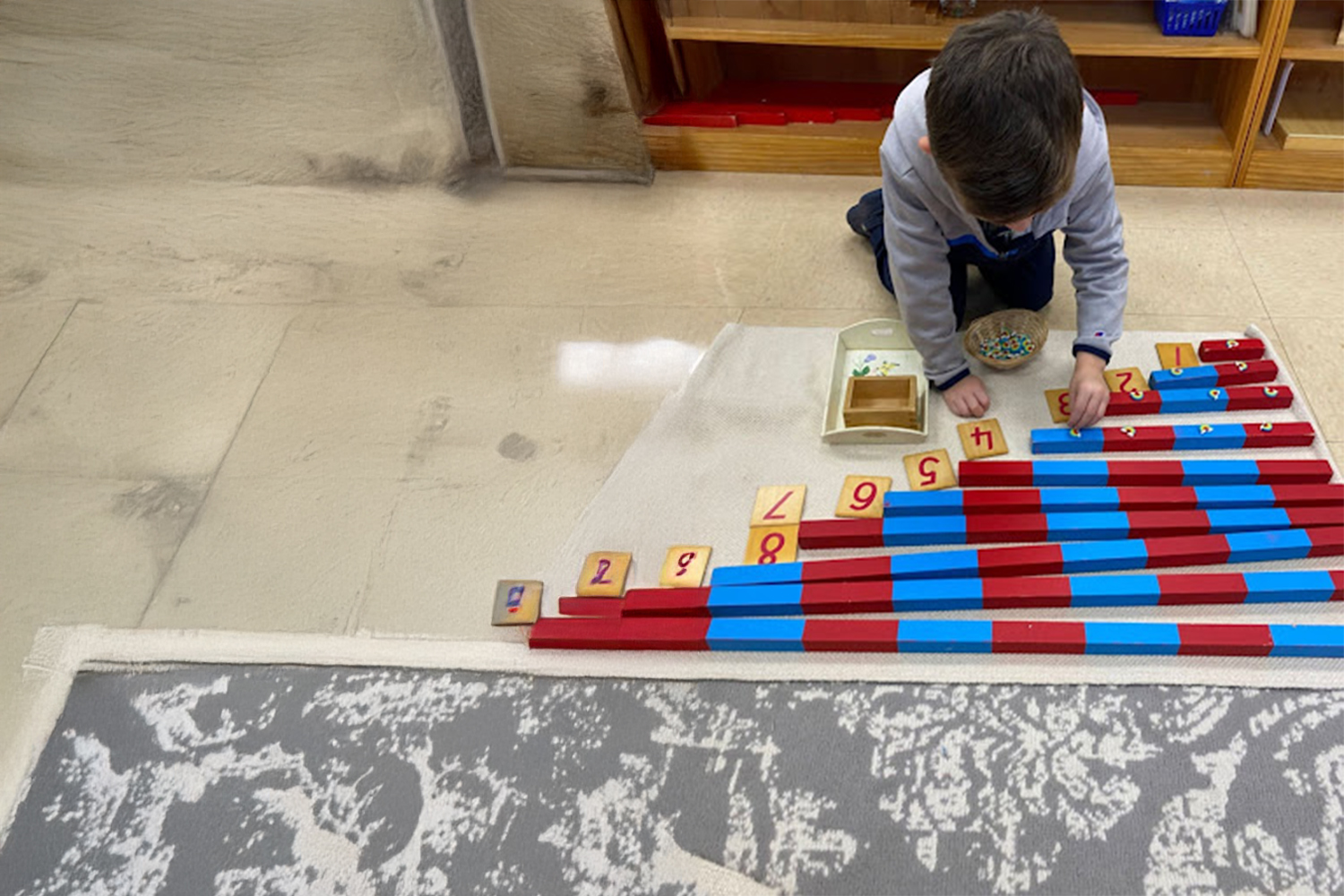
Red and Blue Rods
To the right, the child is working with the Red and Blue Rods. This is numeration work, assigning a written number to quantities one through ten. How the rods are painted indirectly prepares the child for odd and even numbers. It also demonstrates greater than and less than comparisons; because of how the rods line up against one another, the quantity is easily visible.
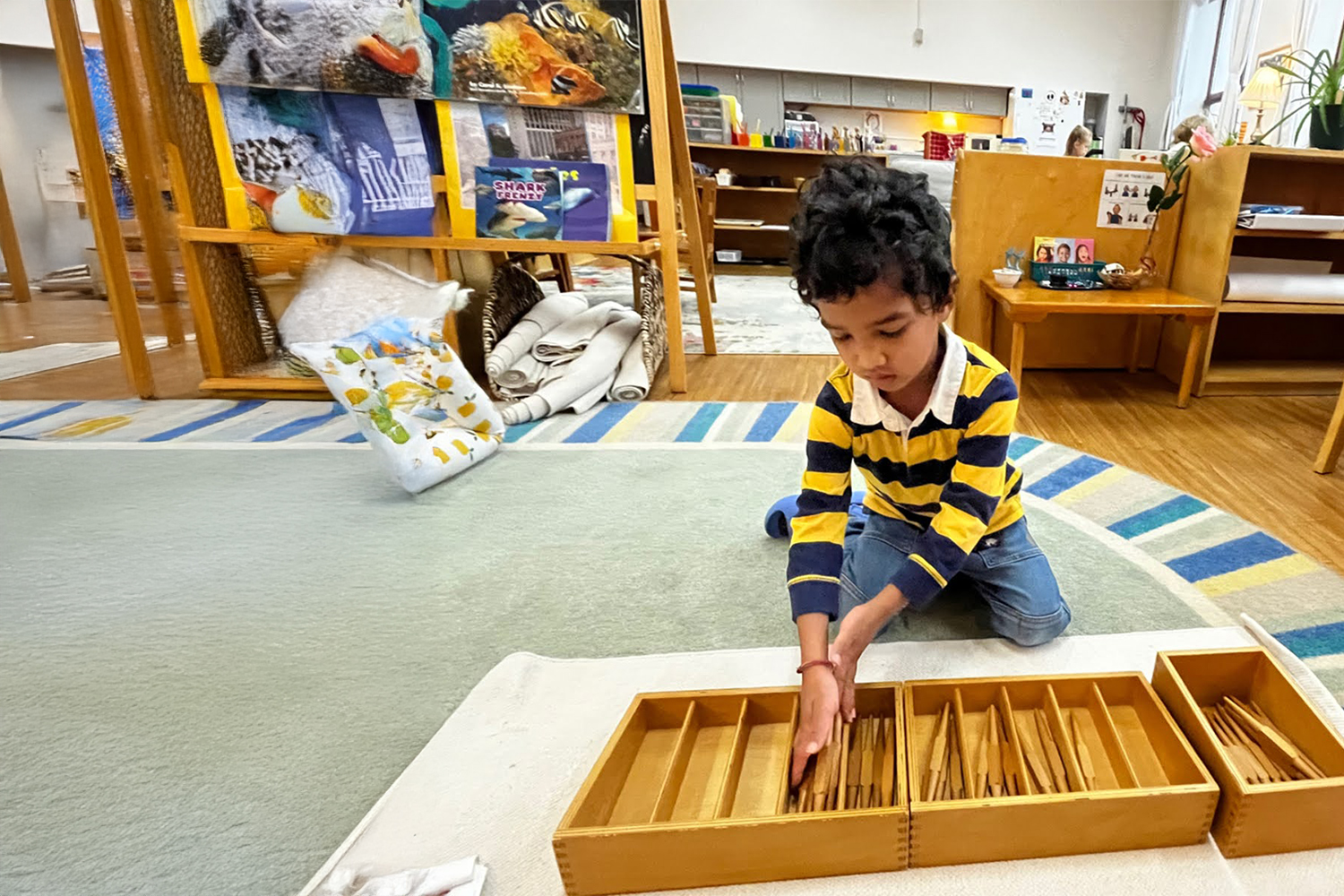
Spindle Boxes
The student pictured here is working with a counting work, the Spindle Boxes. These boxes have spaces labeled for spindles from 0 to 9. The child must count the correct number of spindles in each space. The work, like many Montessori works, is self-correcting. There are only the exact number of spindles, so if a mistake is made, the child will often find it themselves.
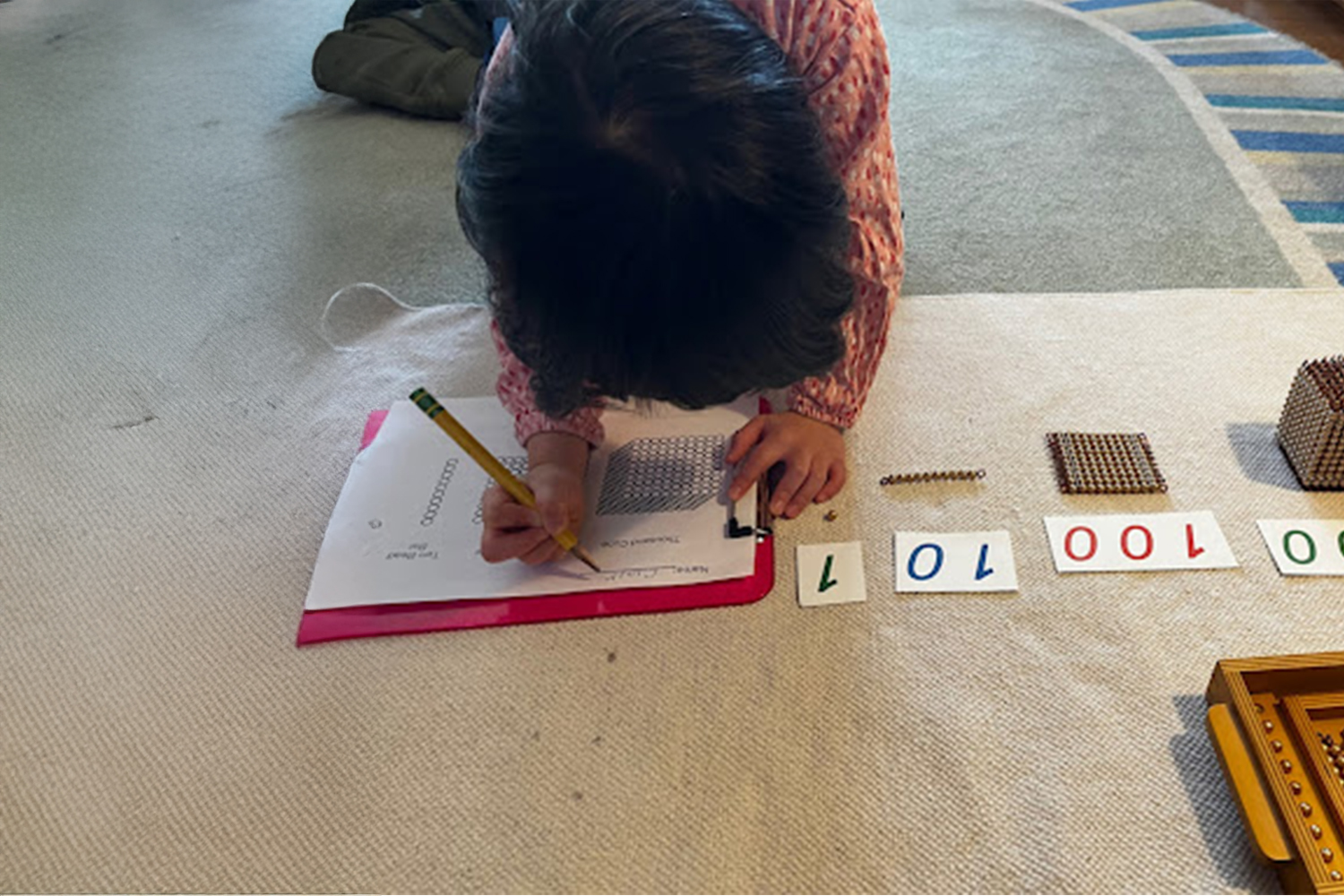
Golden Bead One Tray
This child is working with the Golden Bead One Tray to learn the names of the place values and observe the quantity differences.

Teen Boards
To the right, the student uses the Teen Boards to create teen numbers using a ten-bead bar and then the appropriate number bead bar. She is also building the number on the board with number tiles.
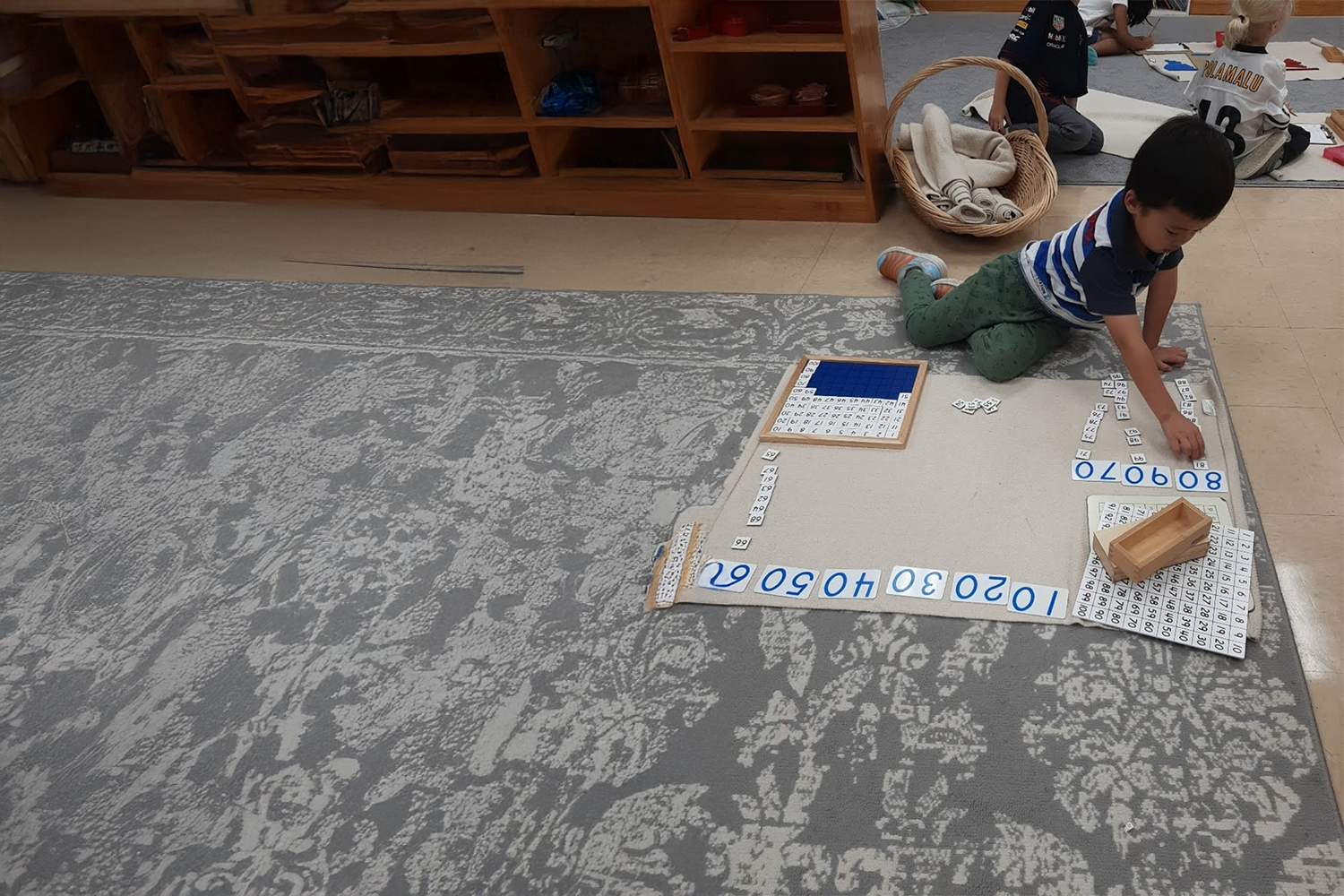
Hundred Board
The child pictured is completing the Hundred Board. This work counts the numbers from one to a hundred and is organized in tens. The counting is accomplished by placing wooden tiles on the board. There are no extra tiles, so the child can see if something doesn’t seem correct - and revise their work.
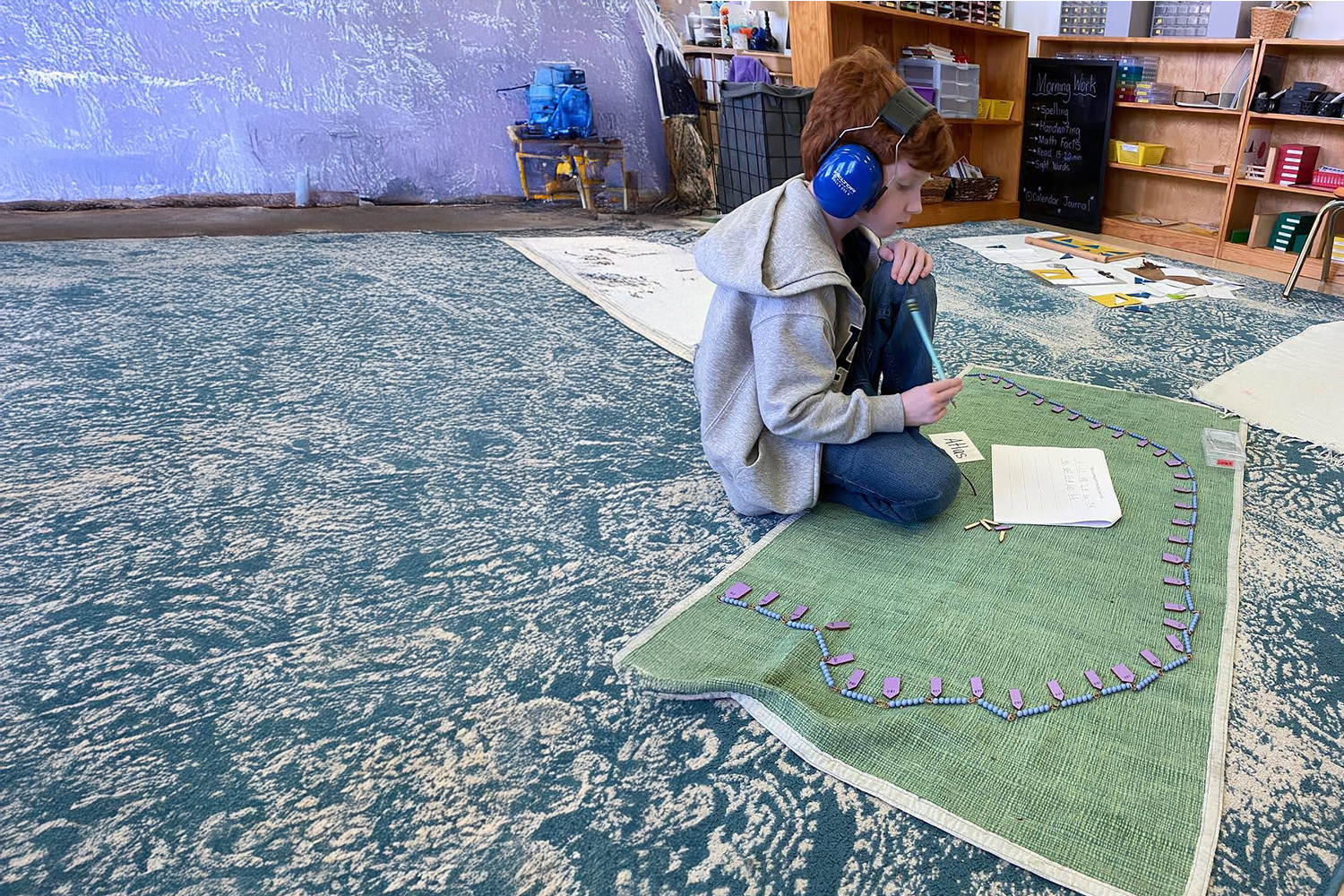
Long Chain
The student pictured is recording their work from the Long Chain of Six. This hands-on material helps students reinforce counting and skip counting. It is self-correcting (it has tags placed after every set of six beads) and, when folded correctly, becomes the cube of six, so students have a concrete understanding of what six three ways look like.

Golden Bead Material
This student is pictured working with Golden Bead Material. This material shows the quantity concretely, providing a visual and sensorial experience to aid in understanding the concept. He has his problem laid out on a place value mat and combines the addends below the line at the bottom to find the sum. He will exchange ten of those in his bank if he discovers he has more than nine in any of the places on his mat.
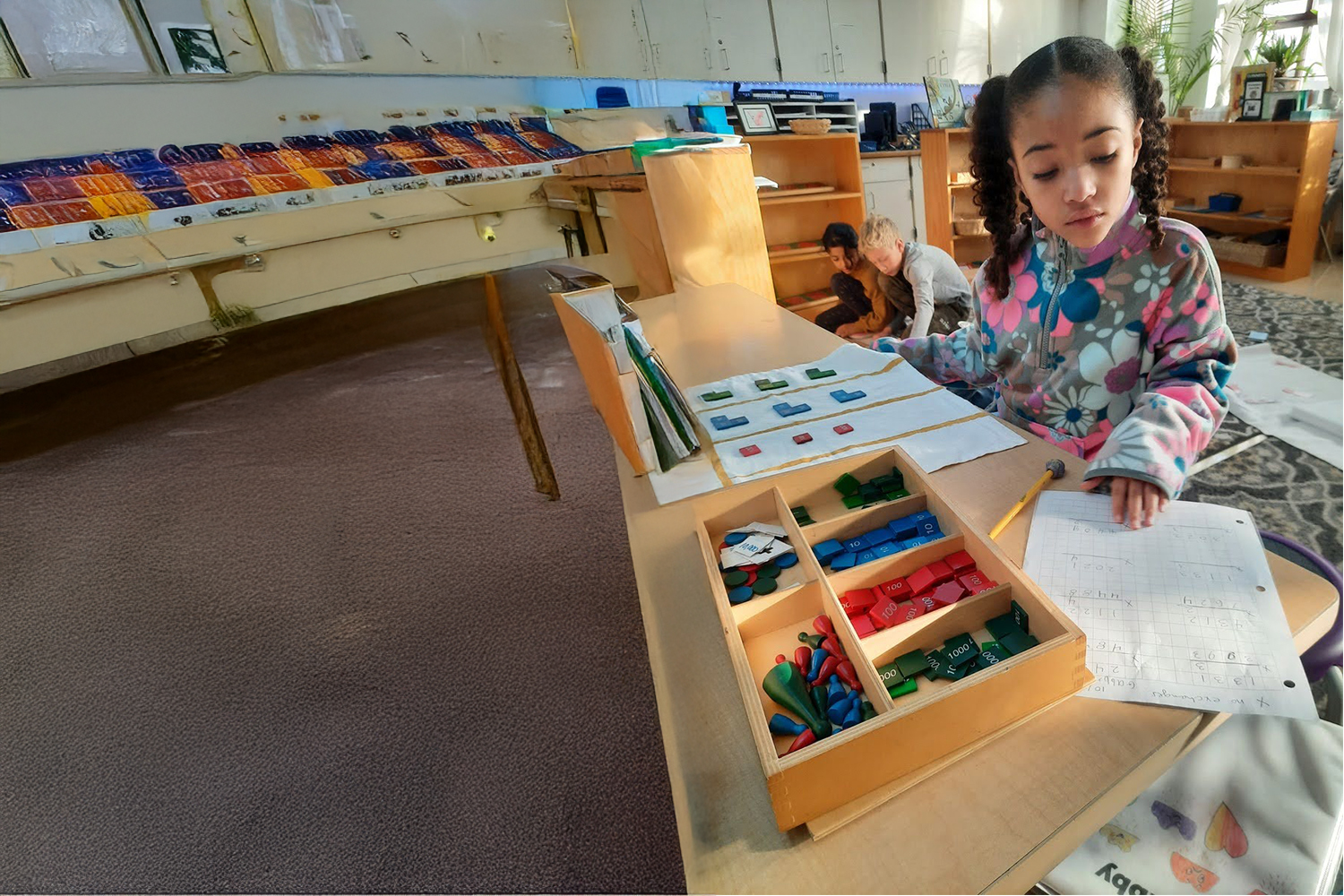
Stamp Game
The student to the right is using the Stamp Game for multiplication. She has moved her multiplicands into sets; the multiplier determines the number of sets she needs. Once each set is laid out, she will combine those to find the product.

Large Bead Frame
The Large Bead Frame that the student uses is a Montessori math material that bridges the concrete and abstract for many students. The beads are moved from left to right and top to bottom, with the very top line of beads representing the units. This material can be used for addition, multiplication, and subtraction operations.
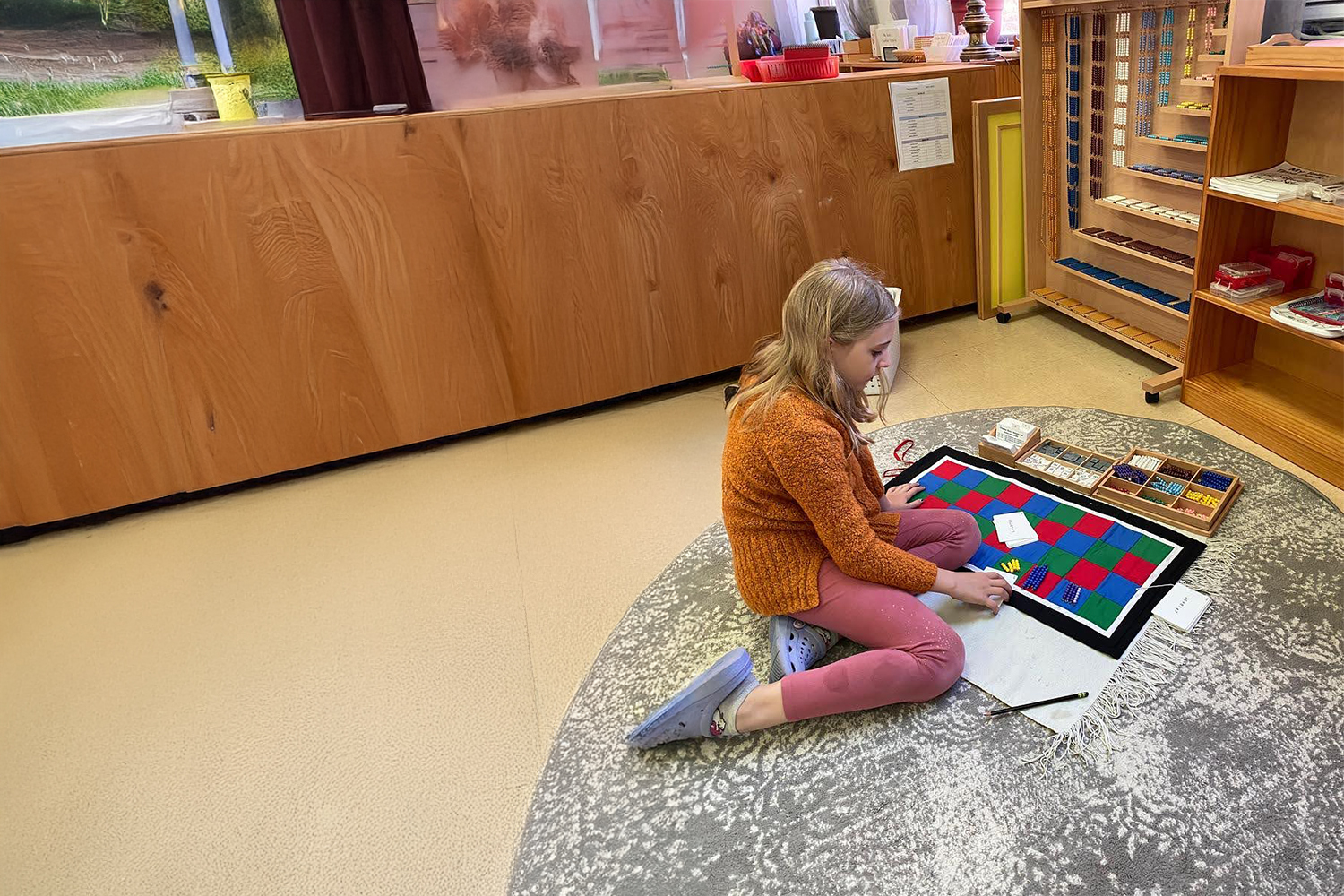
Checkerboard
The Checkerboard is a Montessori math material specifically designed to assist children in practicing multiplication with numbers up to 100,000,000. It is color-coded in the familiar green, blue, and red colors, helping the students stay organized and compute the numbers in their equations.

Test Tubes
The child pictured uses the Test Tube Division material also called Racks and Tubes. This material requires students to place their divisors on wooden boards with divots and then divide their dividends--the beads in the cups--between them equally. This material helps to strengthen the student’s understanding of the division process.

Algebraic Peg Board
Here, a student is building squares using the Algebraic Peg Board. This work strengthens the student's knowledge of multiplication, provides a visual understanding of the binomial, and prepares for future work of extracting square roots.


“Montessori often used to remark ‘present the child with materialized abstraction.’ By this she meant, ‘present the idea in a material or concrete form’ and always combined with an activity. As the child works for a long time with this material day after day…at his own pace, unperturbed, unhurried, gradually there comes off from the materials the very essence of the operation…’ Always the child works the operation…’ Always the child works the operation first in the concrete until the very essence of the rule becomes absolutely clear to him.”
-E. M. Standing, Maria Montessori: Her Life and Work